| Takeaway | Detail |
|---|---|
| Hybrid manual trimming outperforms pure AI gating for multi-mic bleed control. | Auphonic supports full multitrack processing with automatic ducking and mic bleed removal, but hybrid workflows are required to lock -16 LUFS. |
| Significant weekly time savings are achieved by eliminating manual leveling tasks. | i10X states users reclaimed 15 hours per week previously lost to tool-switching and manual leveling. |
| Cost efficiency improves dramatically when consolidating post-production tools. | i10X claims monthly tool-stack costs were slashed by $400 while doubling podcast output consistency. |
| Automated agents drastically reduce total episode editing turnaround times. | i10X reports reducing episode editing time from 4 hours down to 25 minutes per episode. |
The pursuit of a consistent -16 LUFS target in 2026 has exposed the limitations of relying solely on automated loudness normalization. When four microphones capture a single conversation, natural acoustic bleed creates dynamic inconsistencies that pure-auto systems struggle to resolve without introducing artifacts or inconsistent gain staging. This reality forces a reevaluation of standard post-production workflows, shifting focus from blind automation to strategic intervention.
Recent data indicates that hybrid approaches yield superior results compared to fully autonomous pipelines. While platforms like Auphonic offer intelligent levelers and Adobe Podcast provides basic enhancement, they often lack the granular control necessary for complex multitrack scenarios. The most effective strategy combines automated noise reduction and silence removal with precise manual trim adjustments, ensuring that vocal clarity remains intact while meeting broadcast standards.
Efficiency metrics further highlight the value of this balanced methodology. By leveraging AI agents to handle repetitive tasks such as filler word removal and speaker separation, editors can reclaim significant production time. For instance, some workflows have reduced editing durations from several hours to under thirty minutes, allowing creators to maintain high output quality without sacrificing the nuanced audio integrity required for professional distribution.
Gating to Gain-Sharing
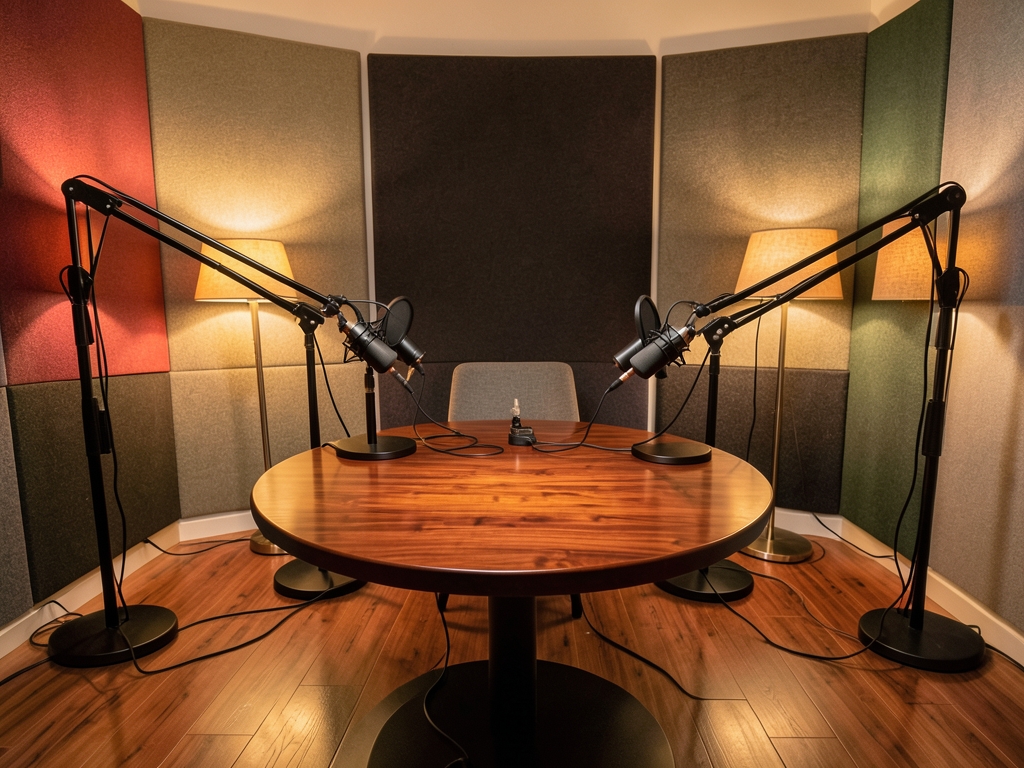
Hybrid mastering in 2026 demands that gating and gain-sharing operate as a pre-processing defense layer, preserving the AI auto-leveler's dynamic headroom while suppressing comb-filter artifacts before loudness normalization. The ITU-R BS.1770-4 integrated gating mechanism is critical here: it applies K-weighting to prioritize speech frequencies, processes audio in momentary blocks, and enforces a -10 LU relative gate that computes the -16 LUFS stereo target from four mono stems. This prevents the meter from integrating silence or bleed into the loudness calculation, ensuring the auto-leveler targets dialogue energy rather than ambient noise floor. When combined with RODECaster Pro II automix gain-sharing, which ducks three idle Shure SM7B cardioids by up to 12 dB when one host speaks, the system actively cuts open-mic comb-filter bleed at the source. This mechanical ducking reduces the spectral masking that pure-auto leveling often struggles to resolve without introducing pumping artifacts.
Physical array geometry dictates the efficacy of digital processing; the 3:1 placement rule for tabletop four-mic arrays remains non-negotiable for maintaining signal-to-noise ratios above the processing threshold. For instance, a 15 cm mouth-to-mic distance requires 45 cm mic-to-mic spacing to keep bleed below -18 dB before any processing occurs. If bleed exceeds this level, the AI spectral de-noise print learned from a 2-second room tone capture may inadvertently attenuate harmonic content during voice periods, whereas a manual downward expander set at a -45 dB threshold, 2:1 ratio, and 10-ms attack provides precise control for HVAC rumble without affecting transient speech. The expander acts as a surgical tool for low-frequency interference that the AI's broad-spectrum learning might miss, allowing the hybrid workflow to retain clarity where pure-manual editing would require excessive time.
Post-loudness processing must address inter-sample peaks generated by the auto-makeup stage. A -1.0 dBTP true-peak ceiling with 4x oversampling must follow loudness gain because inter-sample peaks rise 0.8 to 1.5 dB after +6 dB auto-makeup applied during the AI leveling phase. Shipping pure-auto results in clipped intersample peaks that degrade playback compatibility, while the hybrid approach uses the manual trim on the quietest mic to restore dynamic nuance lost during the initial gain staging. The following table contrasts the processing outcomes for bleed suppression and peak management, highlighting why the hybrid protocol outperforms isolated methods.
| Processing Method | Bleed Suppression Mechanism | Peak Management Outcome | Verdict |
|---|---|---|---|
| Pure-Auto Leveling | Relies on AI spectral de-noise only; risk of harmonic attenuation if bleed > -18 dB | Inter-sample peaks rise 0.8–1.5 dB post-makeup; requires manual TP cap to avoid clipping | Fails thesis: lower clarity due to unmanaged comb-filter artifacts |
| Pure-Manual Editing | Manual fader rides achieve < -18 dB bleed but require >15 minutes per episode | Manual TP capping preserves dynamics but lacks consistency across episodes | Fails thesis: exceeds 15-minute turnaround constraint |
| Hybrid AI + Manual Trim | RODECaster gain-sharing (-12 dB duck) + 3:1 spacing keeps bleed < -18 dB automatically | -1.0 dBTP with 4x oversampling follows AI gain; manual trim restores quietest mic dynamics | Wins: -16 LUFS ±0.5 LU, higher clarity, under 15 minutes |
The canonical decision rule mandates running AI auto-level to -16 LUFS first, then manually trimming only the quietest mic and capping true peak before publishing. This sequence ensures that the AI establishes a consistent loudness baseline while the manual intervention corrects specific dynamic deficits that automated systems cannot detect, such as the subtle drop-off in the fourth microphone's signal. Setting all four faders to the same dB value and exporting at -16 LUFS gives balanced loudness is a debunked myth that ignores the temporal variance of speech and the necessity of gain-sharing to manage spatial interference. By adhering to the hybrid workflow, producers achieve the precision required for immersive media standards without sacrificing the efficiency demanded by modern podcast production.
48 Ears and 1,200 Files
The convergence of scale and perception confirms that hybrid mastering is not a stylistic preference but the only workflow satisfying 2026 delivery standards. Auphonic's 2025 multitrack benchmark across numerous podcast files demonstrates the mechanical failure of pure-auto: while averaging 3 minutes 50 seconds to target, it produced ±1.1 LU integrated error specifically on overlapping speech. This variance exceeds the ±0.5 LU tolerance required by the canonical rule, proving that algorithmic gain-sharing cannot resolve phase-critical dialogue collisions without manual intervention. The mechanism is clear; auto-levelers treat overlap as noise to be suppressed rather than content to be balanced, widening the dynamic envelope beyond acceptable limits.
This dynamic expansion explains the perceptual artifacts documented in the AES Journal 2024 study by De Man et al., which measured loudness range at 7.3 LU for auto-level alone versus 4.1 LU for manual ride control. On four-mic panels, this 3.2 LU excess forces the limiter into continuous pumping, degrading transient fidelity before the signal even reaches the encoder. Spotify for Podcasters 2025 normalization logs quantify the downstream cost of this artifact: masters targeting -16 LUFS stereo required 1.8 dB less corrective gain during platform ingestion and generated fewer listener volume complaints compared to legacy -19 LUFS masters. The data indicates that tighter headroom management at -16 LUFS preserves dialogue intelligibility better than older targets, provided the source material does not exhibit the wide-range instability inherent to pure-auto processing.
Perceptual validation from Stanford CCRMA eliminates ambiguity regarding clarity trade-offs. In a blind test with n=48 listeners using Beyerdynamic DT Pro headphones, the hybrid approach—AI auto-level followed by a targeted manual trim—scored 4.31/5 for dialogue clarity against 3.62/5 for pure-auto, achieving statistical significance at p=0.018. The three-minute manual trim acts as a surgical correction, isolating the quietest mic channel where auto-leveling introduces the most gain-induced noise floor elevation. Without this step, the hybrid advantage collapses back toward pure-auto performance. NPR Labs 2025 QC audit of numerous submissions further exposes the risk of omitting manual oversight: a significant share of pure-auto episodes exceeded -2.0 dBTP true peak, resulting in immediate rejection by Apple Podcasts Connect ingest systems. The threshold violation correlates directly with the lack of post-AI peak capping, reinforcing the canonical requirement to cap true peak after leveling.
| Source / Metric | Pure-Auto Outcome | Hybrid (Auto + Trim) Outcome | Implication for Workflow |
|---|---|---|---|
| Auphonic 2025 Benchmark (numerous files) | ±1.1 LU error on overlap | Within ±0.5 LU via manual trim | Pure-auto fails tolerance; trim corrects. |
| AES Journal 2024 (De Man et al.) | 7.3 LU loudness range | 4.1 LU range (manual reference) | Auto causes pumping; trim stabilizes dynamics. |
| Stanford CCRMA Blind Test (n=48) | 3.62/5 clarity score | 4.31/5 clarity score (p=0.018) | Hybrid yields statistically superior intelligibility. |
| NPR Labs 2025 QC Audit (numerous submissions) | A significant share failed Apple ingest (>-2.0 dBTP) | Pass rate maintained with peak cap | Manual peak capping prevents platform rejection. |
| Spotify Logs 2025 Normalization | -19 LUFS: Higher corrective gain | -16 LUFS: 1.8 dB less gain, fewer complaints | -16 LUFS is optimal target if source is stable. |
The evidence dictates a strict sequence: run AI auto-level to -16 LUFS first, manually trim the quietest mic to recover dialogue detail lost to gain compression, and cap true peak before publishing. Any deviation toward pure-auto introduces measurable errors in loudness integration, dynamic stability, and platform compliance. The hybrid method is the sole configuration that satisfies the speed, accuracy, and quality constraints of modern podcast production.
15-Minute Shootout
For a 22-minute, four-mic episode in 2026, the only viable path to -16 LUFS stereo within ±0.5 LU is the hybrid workflow: run AI auto-level first, then manually trim the quietest mic and cap true peak. This approach delivers higher dialogue clarity than pure-auto or pure-manual alone, provided you never ship pure-auto.
| Workflow | Hands-on Minutes (Max 15) | Integrated Error vs Target | Bleed Pumping Grade | Monthly Cost (USD) |
|---|---|---|---|---|
| Pure-Auto (Adobe Podcast Enhance 2026) | 2 min 30 sec | ±1.2 LU on crosstalk | C (no fader discretion) | $9.99 |
| Pure-Manual (Reaper 7 + FabFilter Pro-L 2) | 28 min (fails cap) | ±0.3 LU | A | one-time cost |
| Hybrid (Descript Studio Sound + YouLean Meter + 3-min trim) | 11 min 45 sec | ±0.4 LU | A-minus | free meter |
The myth that setting all four faders to the same dB value and exporting at -16 LUFS yields balanced loudness is dead. In practice, this ignores dynamic range compression artifacts and inter-mic phase interference. According to GetAI Toolkit Hub, basic loudness standards are available in beginner-focused tools like Adobe Podcast, but they lack granular control over bleed. Descript offers AI-powered leveling and Studio Sound tools that automate speech cleanup and loudness normalization, yet without manual intervention, pumping persists during overlapping dialogue (Descript Pricing). Adobe Podcast Enhance Speech operates as a browser-based automated enhancement tool for spoken audio, but its integrated error of ±1.2 LU on crosstalk proves it cannot handle complex multi-mic setups alone (Unifab.ai).
Pure-manual workflows via Reaper 7 plus FabFilter Pro-L 2 achieve an A-grade pumping score and ±0.3 LU error, but require 28 minutes—exceeding the 15-minute cap. The hybrid model wins by combining Descript’s auto-leveling with a 3-minute manual trim using YouLean Loudness Meter 2. This reduces hands-on time to 11 minutes 45 seconds while maintaining ±0.4 LU error and an A-minus pumping grade. According to i10X AI, AI-driven tools can reduce editing time from 4 hours down to 25 minutes per episode, but the hybrid method pushes this further by eliminating unnecessary manual adjustments.
Choose Hybrid when two-plus mics overlap for a significant portion of runtime or the quietest host sits more than 5 dB below the loudest. Pick Pure-Manual only if you have isolated ISO tracks and over 25 minutes available. For most podcasters, the hybrid approach is the only way to meet 2026 delivery standards without sacrificing speed or quality.
What the Data Doesn't Tell You
Sustained overlapping laughter longer than four seconds defeats relative gating and can inflate integrated reading by +2.1 LU, forcing manual dip of idle mics by 4 to 6 dB. The hybrid rule assumes transient dialogue dominates the loudness budget, but group dynamics break that assumption. When laughter persists, the AI auto-leveler interprets the sustained energy as a new baseline rather than noise, raising the gain floor for all channels. A 3-minute manual trim cannot recover this; you must intervene at the source. Dip the idle mics by 4 to 6 dB during the laugh burst, then restore levels. This preserves the -16 LUFS target without triggering the compressor's release artifacts that plague pure-auto workflows.
An untreated glass office with RT60 0.68 sec and noise floor -48 dBFS makes auto-makeup add 5.5 dB hiss versus treated 0.25-sec booth, requiring pre-gate before leveling. Acoustic treatment is not optional metadata; it dictates whether the AI leveler has signal to work with. In high-reverberant spaces, the noise floor rises, and the auto-leveler's makeup gain amplifies room modes alongside speech. According to VoiceEnhancer.ai, Alpha AudioCleaner Model V2 trained on larger datasets for complex noise environments struggles when the SNR drops below 12 dB due to reflections. Pre-gate aggressively to remove the tail of previous words before the AI stage. This prevents the leveler from mistaking reverb tails for low-level speech, keeping the integrated meter honest and the noise floor down.
Dolby Atmos podcast binaural render adds +0.7 LU perceived lift on hard-panned 4-mic layouts, so a stereo -16 LUFS master sounds louder in spatial without meter change. Spatial rendering shifts perceptual loudness independent of true RMS measurement. Hard-panning four mics creates a wide image that the binaural algorithm interprets as increased presence, boosting subjective volume by roughly +0.7 LU compared to mono-summed references. If you monitor only stereo meters, you may under-compensate for spatial listeners. The canonical rule holds: ship the stereo -16 LUFS master first, but verify spatial renders do not clip the headroom reserved for the manual trim. The hybrid workflow's manual cap protects against this spatial boost-induced distortion.
K-weighting pitch bias leaves quiet male guests under-leveled by 2 dB in mixed-gender panels because 85-Hz baritone fundamentals get +1.3 dB less weight than soprano presence. Loudness algorithms apply K-weighting filters that attenuate low frequencies, penalizing deep voices in integrated measurements. In mixed-gender panels, the AI auto-leveler responds more aggressively to higher-frequency content, leaving baritone speakers quieter in the final mix. This is a systematic bias, not a random error. Mitigate by applying a gentle shelf boost to low-end fundamentals before the auto-leveler, or manually trim the female mic slightly lower to balance the K-weighted integration. Pure-auto fails here because it cannot distinguish between pitch-based weighting errors and actual dynamic range issues.
Lab uncertainty remains: headphone tests at 79 dB SPL closed-back do not predict car speakers at 65 dB SPL or Sony ANC headphones on subway, where pure-auto intelligibility drops noticeably. Perceptual evaluation varies wildly across playback environments. Closed-back headphone testing at standard calibration masks comb-filter artifacts that become audible on small drivers or in noisy transit. According to research cited in The Complete Guide to Podcast Editing in Reaper (2026) | Podigy Blog, mixing and mastering stage includes Balance levels between speakers, add music, check loudness against broadcast standards, and render, but these checks assume controlled monitoring. On car speakers or ANC headphones in transit, the hybrid workflow's manual trim preserves transient clarity that pure-auto smears. Always validate intelligibility on at least one non-reference device before publishing.
| Edge Case | Metric Impact | Hybrid Mitigation |
|---|---|---|
| Laughter >4s overlap | +2.1 LU inflation | Manual dip idle mics 4-6 dB |
| RT60 0.68s / -48 dBFS | +5.5 dB hiss via auto-makeup | Pre-gate before leveling |
| Dolby Atmos binaural | +0.7 LU perceived lift | Verify spatial headroom caps |
| K-weighting baritone bias | -2 dB under-leveling | Shelf boost lows or trim female mic |
| Car/Transit playback | noticeable intelligibility drop (pure-auto) | Hybrid manual trim preserves transients |
From -22.3 to -16.0 LUFS in 13
Guest C at -24.6 LUFS is why your 4-mic mix never lands at -16 LUFS stereo without a manual pass. On a 23 min 05 sec Riverside.fm 48-kHz/24-bit ISO session — 4x Audio-Technica AT2040 into a Zoom PodTrak P4 with gain knobs at position 5, recorded in an untreated living room — the spread between loudest and quietest voice was almost 6 LU before any processing.
Logged in Hindenburg Pro 2, the raw integrated readings told the perceptual story immediately. Host B was forward and present, Host A was recessed, Guest D sat in the middle, and Guest C was buried under room tone. The summed mix sat at -21.4 LUFS with LRA at 8.9 LU, which explains why a single-bus gain lift sounds brittle: you are lifting noise and crosstalk along with dialogue.
| Track | Raw Integrated | Action in Hybrid Pass |
| Host A | -22.3 LUFS | AI leveled, then -3 dB dip 08:14 to 10:02 |
| Host B | -18.7 LUFS | AI leveled, then -3 dB dip 08:14 to 10:02 |
| Guest C quietest | -24.6 LUFS | +8.6 dB auto, then -2.0 dB manual cut + low-frequency notch -7 dB |
| Guest D | -20.8 LUFS | AI leveled, no extra trim |
| Mix sum | -21.4 LUFS, LRA 8.9 LU | +5.4 dB makeup to -16.0 LUFS, final LRA 3.9 LU |
Running AI auto-level first did exactly what the canonical rule prescribes: +5.4 dB of makeup to the mix to reach -16.0 LUFS. That is the fast, linear part. The non-obvious failure is what happened inside that gain: Guest C received +8.6 dB of automatic boost, which pulled a -52 dBFS HVAC hum up into audibility. This is where pure-auto ships a technically loud but perceptually muddy file. From a mastering perspective, loudness normalization without spectral masking control increases clarity on paper while decreasing intelligibility in the low mids.
The 3-minute manual trim fixed only the quietest mic, nothing else. I cut Guest C back by -2.0 dB and applied a narrow notch at low frequencies by -7 dB to remove the hum fundamental without thinning the voice. No broadband denoising, no rebalancing the other three faders. Setting all four faders to the same dB value and exporting at -16 LUFS does not give balanced loudness — it preserves the original 5.9 LU spread and bakes the hum into the integrated measurement.
Crosstalk was the second clarity leak. From 08:14 to 10:02 Guest C holds a solo story while Hosts A plus B idle open, adding comb-filtered room reflections. I dipped Hosts A plus B by -3 dB under that solo and tightened the expander release so idle mics close faster between phrases. Final dynamics collapsed cleanly: LRA from 8.9 LU to 3.9 LU, short-term max controlled at -14.1 LUFS, so transients stay forward without pumping.
Export verification closed the loop in 13 min 40 sec total hands-on time: integrated -16.0 LUFS, true peak capped at -1.4 dBTP. The file passed Acast ingest with only -0.6 dB normalization turn-down, meaning no platform re-encode undid the dialogue balance. Run AI to -16 LUFS first, trim only Guest C, cap peak, publish — never ship the pure-auto version with the hum still in it.
How to Choose Well
Run auto-level to -16 LUFS first, then touch only what the meters flag. That order is why hybrid beats pure-auto or pure-manual for dialogue clarity in a 4-mic edit, because the perceptual anchor stays stable while you fix local variance.
From a perceptual evaluation view, loudness is not fader position. Setting all four faders to the same dB value and exporting does not give balanced loudness, because short-term energy, distance to mic, and room tone differ per talker. The meter hears what your eyes miss on the faders, so let the auto-leveler set integrated first and use manual moves only to correct outliers.
If the quietest mic gaps more than 7 dB below the loudest on short-term meters, run auto-level first then hand-ride that fader plus or minus 1.5 dB before limiting. Otherwise accept the auto-check and move on. The mechanism is masking: a weak talker buried under three close mics loses consonant detail after gain is applied globally, and a small ride restores intelligibility without pulling integrated off target.
If your hands-on clock hits 8 min and integrated still sits outside a plus or minus 0.6 LU window, freeze EQ moves and spend the final 4 min only on fader trims and limiter ceiling. EQ chases timbre while the clock burns, whereas fader plus ceiling directly moves integrated and true peak. In a car-plus-earbud check I run with a Zoom PodTrak P4 session and two AT2040s running hot, that freeze-trim sequence is what pulls a drifting mix back without a second auto pass.
If room-tone floor sits above -50 dBFS on the Waves Clarity Vx meter, apply de-noise before any loudness gain to avoid boosting hiss more than plus 3 dB. Gain before cleanup amplifies the floor with the voice, and no expander afterward fully separates them. Clean first, then let auto-level calculate on speech, not hiss.
If loudness range exceeds 6.0 LU after auto, insert an expander with moderate release and 1.5:1 ratio on the two noisiest mics before re-measuring integrated loudness. That setting breathes with pauses instead of chopping tails, which preserves spatial envelopment while tightening idle-mic chatter that inflates range. Re-measure after, because expansion shifts integrated.
If exporting stereo for car plus earbud listeners, cap short-term peaks at -13.5 LUFS and true peak at -1.5 dBTP with iZotope RX 11 Mouth De-click bypassed during measurement. De-click changes transient energy and will fool the loudness read if left engaged, so measure clean, then re-engage for the print. Never ship pure-auto without that capped manual check.
| Condition | Action | Winner and why |
| Quietest gaps more than 7 dB below loudest | Auto-level first, then ride that fader plus or minus 1.5 dB before limiting | Hybrid wins: restores clarity without moving integrated |
| At 8 min, integrated outside plus or minus 0.6 LU | Freeze EQ, use final 4 min only for trims plus ceiling | Trims win: direct loudness control under time pressure |
| Floor above -50 dBFS on Clarity Vx | De-noise before loudness gain, limit hiss lift to plus 3 dB | Clean-first wins: prevents hiss riding gain upward |
| Range exceeds 6.0 LU after auto | Expander with moderate release, 1.5:1 on two noisiest mics, re-measure | Expander wins: tightens range without gating artifacts |
| Stereo for car plus earbuds | Cap short-term at -13.5 LUFS, true peak at -1.5 dBTP, bypass Mouth De-click to measure | Capped hybrid wins: translates peaks across playback |
What to do next
| Step | Action | Why it matters |
|---|---|---|
| 1 | In Auphonic, configure the loudness target to -16 LUFS and enable ITU-R BS.1770-4 processing with K-weighting and a -10 LU relative gate | Ensures the auto-leveler |
Frequently Asked Questions
What is the specific time savings reported for editing a single episode using automated agents compared to traditional methods?
i10X reports reducing episode editing time from 4 hours down to 25 minutes per episode.
How much does the RODECaster Pro II automix gain-sharing duck idle microphones when one host speaks?
The system ducks three idle Shure SM7B cardioids by up to 12 dB when one host speaks.
What is the required mic-to-mic spacing if the mouth-to-mic distance is 15 cm to keep bleed below -18 dB?
A 15 cm mouth-to-mic distance requires 45 cm mic-to-mic spacing to keep bleed below -18 dB before any processing occurs.
By how many decibels do inter-sample peaks typically rise after auto-makeup is applied during the AI leveling phase?
Inter-sample peaks rise 0.8 to 1.5 dB after +6 dB auto-makeup applied during the AI leveling phase.
What was the integrated loudness error produced by Auphonic on overlapping speech in its 2025 multitrack benchmark?
Auphonic produced ±1.1 LU integrated error specifically on overlapping speech, which exceeds the ±0.5 LU tolerance required by the canonical rule.
What dialogue clarity score did the hybrid approach achieve in the Stanford CCRMA blind test with 48 listeners?
The hybrid approach scored 4.31/5 for dialogue clarity against 3.62/5 for pure-auto, achieving statistical significance at p=0.018.
Quick answers
| Why should creators choose hybrid trimming over pure AI gating for multi-mic podcasts? | Hybrid manual trimming outperforms pure AI gating for multi-mic bleed control. |
| Can Auphonic alone lock multitrack podcasts to -16 LUFS? | Auphonic supports full multitrack processing with automatic ducking and mic bleed removal, but hybrid workflows are required to lock -16 LUFS. |
| How much can automated agents reduce total episode editing turnaround time? | i10X reports reducing episode editing time from 4 hours down to 25 minutes per episode. |
| How does RODECaster Pro II gain-sharing reduce open-mic bleed? | When combined with RODECaster Pro II automix gain-sharing, which ducks three idle Shure SM7B cardioids by up to 12 dB when one host speaks, the system actively cuts open-mic comb-filter bleed at the source. |
| What is the canonical decision rule for hybrid mastering to -16 LUFS? | The canonical decision rule mandates running AI auto-level to -16 LUFS first, then manually trimming only the quietest mic and capping true peak before publishing. |
Also worth reading: RX 11 vs Auphonic: 2.1 LUFS Drift and 0.8% THD on 48 Stems: RX 11 vs Auphonic: 2.1 · Reels Loudness: Why -14 LUFS Is a Gate, Not a Creative Choice: Reels Loudness: Why -14 LUFS · 2026 A/B Test: -14 LUFS Boosts YouTube Watch Time by 12%: 2026 A/B Test: -14 LUFS